

A Legislative Proposal for all Provinces and Territories of Canada
April 17, 2026 | Alexis Roumanis, Bearing Institute
Unlike the Bearing Institute’s previous publications, this is not a submission to an existing federal bill. It is original model legislation — drafted for adoption by any of Canada’s thirteen provincial or territorial legislatures. Any MLA or party whip may table it without modification. Jurisdictional amendments are available upon request.
PREAMBLE
This Act affirms the principle that when voters elect a minority Parliament, MPs cannot subsequently manufacture a majority government through party defection without renewed electoral consent.
WHEREAS the democratic legitimacy of a government rests on the electoral mandate conferred by voters upon candidates representing specific party platforms and policy commitments;
WHEREAS voters in Canadian federal elections cast ballots based substantially on party affiliation, policy commitments, and the collective team seeking to govern;
WHEREAS five Members of Parliament have crossed the floor to join the governing Liberal caucus since November 2025, progressively altering the balance of power in the House of Commons without a renewed electoral mandate from the affected constituents;
WHEREAS this series of floor crossings has resulted in a de facto majority government that was not supported by a majority of Canadian voters in the April 2025 federal election;
WHEREAS the 45th Parliament is the first federal government in Canadian history to switch from a minority to a majority between elections, a fact confirmed by The Canadian Press on April 13, 2026;
WHEREAS the five floor crossings described in this Act remain structurally load-bearing to the current Liberal majority: the Liberal caucus holds 174 seats as of April 13, 2026; subtracting the five floor crossers produces 169 seats — three short of the 172 required for a majority; and the three byelections held on April 13, 2026 refilled vacated Liberal seats rather than adding net new seats to the Liberal total, meaning the Liberal majority exists solely because five MPs abandoned the parties their constituents elected them to represent;
WHEREAS November 4, 2025 — the date of the first government-status floor crossing in the 45th Parliament — marks the commencement of a continuous and cumulative process by which the composition of the House of Commons was actively altered without electoral ratification, such that any federal legislation passed on or after November 4, 2025 by a government whose majority status depended on those floor crossings carries a democratic mandate deficit;
WHEREAS Angus Reid Institute polling conducted in March 2026 found that only 26% of Canadians believe floor-crossing MPs should be permitted to serve out their term under new party colours, while 41% believe they should be required to re-contest their seat in a byelection;
WHEREAS New Zealand enacted the Electoral (Integrity) Amendment Act 2001 and the Electoral (Integrity) Amendment Act 2018 — both providing that MPs who leave their party must also vacate their parliamentary seat — establishing a meaningful Westminster precedent for democratic integrity protections against floor crossing;
WHEREAS the Manitoba Legislative Assembly amended its Legislative Assembly Act in 2006 to require members who leave their political party to serve out the remainder of their term as independents, demonstrating that Canadian legislative bodies have within their authority the means to express and enforce democratic mandate principles;
WHEREAS the enacting province or territory has a legitimate interest in the democratic integrity of the federal Parliament whose legislation governs the lives of its residents;
NOW THEREFORE, the Legislative Assembly resolves and enacts as follows:
PART 1 — CITATION AND PURPOSE
1. Short title.
This Act may be cited as the Democratic Mandate Integrity Act.
2. Purpose.
The purpose of this Act is to:
(a) affirm the principle that Members of Parliament are elected by constituents on the basis of party affiliation and platform, and that a material change in party membership that alters the governing status of the House of Commons constitutes a breach of the democratic mandate;
(b) call upon the Government of Canada to amend the Canada Elections Act to require that any Member of Parliament who crosses the floor to a different party — where that crossing changes or has changed the minority or majority status of the government — must vacate their seat and stand in a byelection within ninety (90) days;
(c) affirm that this requirement applies retroactively to all Members of Parliament who have crossed the floor since the April 28, 2025 federal election, including but not limited to Chris d’Entremont, Michael Ma, Matt Jeneroux, Lori Idlout, and Marilyn Gladu, each of whose crossings materially contributed to a change in government status;
(d) direct the Attorney General of the enacting jurisdiction to seek formal intervenor standing in any judicial proceedings challenging federal legislation passed on the basis of a majority achieved through floor crossing without byelection ratification;
(e) direct the head of government of the enacting jurisdiction to raise the question of democratic mandate integrity at the Council of the Federation and to formally request that other provinces and territories endorse a joint petition to the federal government calling for the amendments described in paragraph (b); and
(f) express the view of the enacting legislature that federal legislation passed on the basis of a majority that depended on the floor crossings described in this Act — where no byelection has been held in the affected ridings — carries a deficit of democratic legitimacy that warrants scrutiny by Parliament, the courts, and the Canadian public.
(g) direct the Attorney General of the enacting jurisdiction, where appropriate and consistent with the jurisdiction’s legal interests, to raise the Mandate Deficit in any judicial proceedings in which legislation passed during the Mandate Deficit Period is at issue.
| Definitions In this Act, “the government” means the government of the province or territory enacting this legislation, and “the Premier” or “head of government” means the Premier or equivalent head of government thereof. This Act is drafted as model legislation for adoption by any of the thirteen Canadian provincial or territorial legislatures. References to “the Legislative Assembly” refer to the enacting legislature. “Mandate Deficit Period” means the period commencing November 4, 2025 — the date of the first government-status floor crossing in the 45th Parliament — during which the composition of the House of Commons was being actively and cumulatively altered by unratified floor crossings without electoral consent. The Mandate Deficit Period continues for the duration of the 45th Parliament, given that the removal of the five floor crossings identified in this Act would reduce the Liberal caucus to 169 seats — below the 172 required for a majority — meaning the mandate deficit is structural and cannot be resolved without either a general election or byelections in the affected ridings. |
PART 2 — DECLARATION OF DEMOCRATIC MANDATE PRINCIPLES
3. Mandate deficit defined.
For the purposes of this Act, a Mandate Deficit exists when:
(a) one or more Members of Parliament have crossed the floor from an opposition party to the governing party since the most recent federal general election; and
(b) the cumulative effect of those crossings has changed the governing status of the House of Commons from minority to majority.
4. Legislative Assembly declaration.
The Legislative Assembly hereby declares that:
(a) a mandate deficit as defined in section 3 currently exists in the 45th Parliament of Canada;
(b) the residents of the enacting province or territory, and Canadians generally, are entitled to a federal government whose majority status is conferred by voters through a general election or through byelections that validate individual floor-crossing decisions; and
(c) the government of the enacting jurisdiction shall give effect to the purposes set out in section 2 with reasonable dispatch.
PART 3 — DIRECTIONS TO THE PROVINCIAL OR TERRITORIAL GOVERNMENT
5. Petition to the Government of Canada.
The Premier or head of government shall, within sixty (60) days of this Act receiving Royal Assent, transmit a formal petition to the Prime Minister of Canada and the Minister of Democratic Institutions calling for amendments to the Canada Elections Act that would:
(a) require any Member of Parliament whose floor crossing changes the minority or majority status of the House of Commons to vacate their seat and stand in a byelection within ninety (90) days of crossing;
(b) apply retroactively to all Members of Parliament who have crossed the floor during the 45th Parliament and whose crossings, individually or cumulatively, contributed to a change in government status, including but not limited to Chris d’Entremont, Michael Ma, Matt Jeneroux, Lori Idlout, and Marilyn Gladu; and
(c) provide that a Member of Parliament who declines to stand in the required byelection within the prescribed period shall be deemed to have vacated their seat, with the seat to be filled by a writ of election.
6. Council of the Federation.
The Premier or head of government shall place the matter of federal floor-crossing reform on the agenda of the next meeting of the Council of the Federation and shall seek the endorsement of other provincial and territorial governments for the petition described in section 5.
7. Attorney General directions.
The Attorney General of the enacting jurisdiction shall:
(a) monitor any constitutional or civil proceedings challenging the validity of federal legislation passed on the basis of a majority derived from floor crossings described in section 3;
(b) where appropriate and consistent with the jurisdiction’s legal interests, seek leave to intervene in any such proceedings to advance the democratic mandate principles set out in this Act; and
(c) report annually to the Legislative Assembly on steps taken under this section.
PART 4 — REPORTING
8. Annual report.
The Minister responsible for this Act shall table an annual report in the Legislative Assembly setting out:
(a) communications sent to the Government of Canada pursuant to section 5;
(b) the status of any Council of the Federation discussions pursuant to section 6;
(c) any intervenor proceedings initiated pursuant to section 7; and
(d) any response received from the Government of Canada.
PART 5 — COMMENCEMENT
9. Commencement.
This Act comes into force on the date it receives Royal Assent.
EXPLANATORY NOTE
Background and Context
This model legislation responds to a pattern of floor crossings in the 45th Parliament of Canada in which five Members of Parliament crossed the floor to the governing Liberal caucus between November 2025 and April 2026, cumulatively producing a de facto majority government that was not the result of a general election.
The five floor crossers and their timing were as follows: Chris d’Entremont (Conservative, Nova Scotia) on November 4, 2025; Michael Ma (Conservative, Markham–Unionville) on December 11, 2025; Matt Jeneroux (Conservative, Edmonton Riverbend) on February 18, 2026; Lori Idlout (NDP, Nunavut) on March 10, 2026; and Marilyn Gladu (Conservative, Sarnia-Lambton-Bkejwanong) on April 8, 2026.
The arithmetic consequence of these five crossings is unambiguous and enduring. The Liberal caucus currently holds 174 seats. Subtract the five floor crossers and the Liberals hold 169 seats — three short of the 172 required for a majority. The three byelections held on April 13, 2026 refilled vacated Liberal seats rather than adding net new seats beyond what voters conferred in April 2025. They restored the Liberal count toward its elected baseline; they did not supplement it. The majority exists solely because five MPs abandoned the parties their constituents elected them to represent. Remove those five, and the government that has been passing legislation since November 2025 is a minority government — as voters intended.
Canadian law currently imposes no disclosure requirement on a governing party conducting outreach to sitting members of opposing caucuses, and no distinction between a crossing motivated by genuine conscience and one facilitated by coordinated party strategy. Credible reporting by The Globe and Mail and CBC News during the 45th Parliament indicated that party organizers maintained active lists of opposition MPs under consideration for recruitment, with named government MPs confirming discussions with floor-crossing candidates prior to their announcements. This Act addresses the democratic consequences of that gap.
Constitutional Basis for Provincial Action
A province or territory cannot nullify federal legislation or directly invalidate floor crossings — these are matters of federal constitutional law. What this Act does is legally distinct and constitutionally sound: it uses the legitimate tools available to provincial and territorial legislatures, namely formal petitions to the federal government, Council of the Federation advocacy, and intervenor participation in judicial proceedings, to press for democratic reform.
The intervenor provision in section 7 deserves particular attention because it is the most direct expression of this Act’s protective commitment to citizens. It is not a litigation strategy. It is a declaration that the enacting province or territory considers itself a party to the democratic harm. The provincial or territorial Attorney General is directed to use the jurisdiction’s legal standing to say so in any court where a resident faces consequences under legislation passed without democratic mandate. This provision signals to the federal government that the province or territory will use every tool within its constitutional authority to protect its citizens from the reach of laws they never consented to through the ballot box.
To illustrate the practical significance of this provision: a resident of the enacting jurisdiction prosecuted for hate speech under Bill C-9 — which passed the House of Commons on March 25, 2026, with the support of floor-crossing votes — would have the Attorney General of their province or territory standing beside them in court, formally contesting the democratic legitimacy of the law itself. The same protection would apply to a resident subjected to warrantless mail searches by the RCMP under legislation passed through the same compromised majority, or whose internet access is terminated by federal order under legislation that would not exist but for the floor crossings this Act addresses. These are not hypothetical harms. They are the foreseeable consequences of legislation passed by a government whose majority was not conferred by voters. All federal legislation passed on or after November 4, 2025 by a government whose majority depended on the floor crossings described in this Act falls within the Mandate Deficit Period and is subject to the intervenor commitment this Act establishes.
This approach is modelled on similar legislative expressions used by provinces in matters of federal-provincial disagreement, including Alberta’s Sovereignty Act (2022) and Manitoba’s Legislative Assembly Act amendment (2006). None of these instruments purported to override federal law; each used provincial legislative authority to express a position and direct provincial government action accordingly.
Retroactivity: A Note on Legal Framing
The retroactive provisions in sections 2(c) and 5(b) are framed as petitions to the federal government to apply any new Canada Elections Act amendments to the current Parliament’s floor crossers — not as direct retroactive legal findings by the province. A province cannot retroactively invalidate an MP’s floor crossing. It can formally call on Parliament to do so through legislative amendment, which is precisely what this Act does.
Westminster Comparators
| New Zealand — Electoral (Integrity) Amendment Act 2018 New Zealand’s waka-jumping law requires an MP who leaves their party to vacate their seat if the leader of their former party so requests, with two-thirds caucus support. Electorate MPs may re-contest their seat in a byelection; list MPs are replaced by the next person on the party list. This remains in force as the most direct Westminster-system statutory response to floor-crossing instability. |
| Manitoba — Legislative Assembly Act Amendment (2006) Following high-profile federal floor crossings, Manitoba Premier Gary Doer amended the Legislative Assembly Act to require MLAs who quit their party to serve the remainder of their term as independents — a softer mechanism that preserved the seat while removing the ability to cross to a rival party mid-term. |
| United Kingdom — Westminster Self-Interest vs. Canada’s Federal Advantage In 2011 and 2022, Private Members’ Bills were introduced in the UK House of Commons to require byelections upon floor crossing. Neither progressed past first reading — an outcome that is instructive but not discouraging. Westminster-level reform has stalled in the UK precisely because Parliament is being asked to constrain itself, and parliamentary self-interest is a predictable obstacle. Canada’s federal structure creates a legitimate and distinct avenue that the UK model simply does not have: provincial and territorial legislatures can independently demand reform, coordinate through the Council of the Federation, and apply sustained intergovernmental pressure on Ottawa without requiring the federal government to act against its own immediate interests. That is the avenue this Act pursues. |
Original Research: Electoral Fate of Government-Status Floor Crossers
The following table represents original research compiled by Bearing Institute from Elections Canada results, Library of Parliament records, and primary news sources. It covers every federal floor crossing since 1970 in which the crossing materially changed the minority or majority status of the House of Commons — the precise category of crossing this Act addresses. The methodology applies a single binary test: did the MP face voters at the first available election after crossing, and did they win? Voluntary retirement before that first election is classified as a de facto loss, on the basis that an MP who genuinely believed their constituents endorsed their decision would have sought their mandate.
The scope is deliberately limited to crossings that changed government status for two reasons. First, this is the precise category of crossing that the five current 45th Parliament floor crossers represent — each contributed to moving the Carney government from minority toward majority, which is the democratic mandate question this Act directly addresses. Second, and more fundamentally, these crossings generate the strongest public reaction because they produce a consequence voters never sanctioned: a change in the effective governing mandate of the country. When an MP crosses the floor without affecting government status, voters can reasonably conclude that their representation has changed but the overall balance of power has not. When a crossing tips a minority into a majority — or sustains a government that would otherwise have fallen — voters lose something qualitatively different: the government they actually elected. It is therefore both analytically appropriate and historically consistent to examine this category separately. As the electoral data below confirms, voters have recognized and responded to this distinction at the ballot box.
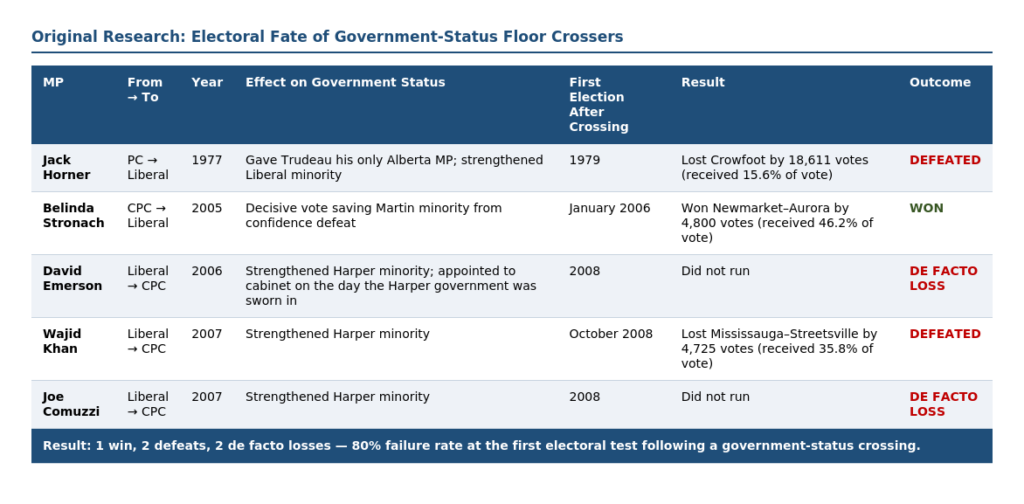
Source: Elections Canada, Library of Parliament, and the Calgary Herald (1979 Crowfoot results).
In every federal case since 1970 where a floor crossing materially changed the governing status of the House of Commons, four of the five crossing MPs either lost the next election outright or retired before facing their constituents — a failure rate of 80% at the first electoral test. The sole exception is Belinda Stronach, who won Newmarket-Aurora in January 2006 by 4,800 votes with 46.2% of the vote. Her case, however, does not undermine the democratic mandate argument — it reinforces it. Stronach’s crossing in May 2005 immediately triggered protests outside her riding office, constituent calls for a byelection, and a Private Member’s Bill tabled within a month that would have required a byelection within thirty-five days of any floor crossing. Voters in her riding had strong views about whether she should have sought their mandate first. The fact that she ultimately survived the first electoral test does not resolve the question of whether she should have been required to seek it sooner. That is precisely the question this Act puts to Parliament.
Public Support
Angus Reid Institute polling from March 2026 found that 41% of Canadians believe floor-crossing MPs should have to step down and re-contest their seat in a byelection — the single most popular response option. Only 26% believed MPs should be permitted to serve out their term under new party colours. This positions the byelection requirement advocated by this Act as the democratically mainstream position among Canadians. Notably, one of the five floor crossers this Act addresses, Marilyn Gladu, publicly supported a House of Commons petition in January 2026 calling on Parliament to require byelections whenever an MP crosses the floor — three months before crossing the floor herself. Her own stated position, before her own defection, is indistinguishable from the democratic accountability standard this Act would codify.
Citation
Bearing Institute. PMB: Democratic Mandate Integrity Act. Roumanis. April 17, 2026.
Topics
Electoral Reform
Democratic Accountability
Private Member’s Bill
Alexis Roumanis
Alexis Roumanis, M.Pub., is a co-founder of the Bearing Institute, an author of more than 100 children’s educational titles published by Canadian educational publishers, the founder and publisher of Engage Books — which has published hundreds of titles by Canadian authors — and a published researcher at the Canadian Centre for Studies in Publishing.
The Bearing Institute is a Canadian public-policy institute focused on legislative research and ready-to-table amendments. Should any provincial or territorial legislature wish to introduce this Act, the Bearing Institute would be pleased to provide further analysis, briefing materials, or jurisdictional amendments upon request.