

Research paper
Policy Submission on Bill C-9: The Combatting Hate Act
Alexis Roumanis, M.Pub. and Matthew Trenholm, MSc • March 18, 2026
Legislative Analysis and Recommendations — Committee-Amended Bill
March 18, 2026 | Alexis Roumanis & Matthew Trenholm, Bearing Institute
Note on version: This submission addresses Bill C-9 as reported back to the House of Commons by the Standing Committee on Justice and Human Rights on March 13, 2026. The committee amended the bill in several significant respects. Where committee amendments have addressed concerns raised in this submission, that is noted. Where the committee’s amendments have created new or worsened concerns, those are addressed directly.
Five Legislative Concerns
Bill C-9, the Combatting Hate Act, was introduced on September 19, 2025, and reported back to the House with amendments on March 13, 2026. Bearing Institute does not oppose the genuine goal of combating hatred in its most extreme manifestations — Canada’s Criminal Code already addresses these under Sections 318 and 319. This submission identifies five areas of ongoing legislative concern in the committee-amended bill, notes where committee amendments have addressed earlier concerns, and identifies one area — the religious expression exemption — where the committee’s amendments have made the bill significantly worse.
Citation
Bearing Institute. Policy Submission on Bill C-9: The Combatting Hate Act. Roumanis & Trenholm. March 18, 2026.
Topics
Crime & Justice
Free Expression
1. The Lowered Definition of Hatred — partially addressed by committee
As introduced, Bill C-9 proposed to add a statutory definition of “hatred” to the Criminal Code: “hatred means the emotion that involves detestation or vilification and that is stronger than disdain or dislike.”
In both R. v. Keegstra (1990) and Saskatchewan Human Rights Commission v. Whatcott (2013), the Supreme Court of Canada defined hatred as an “intense and extreme” emotion. The word “extreme” was deliberate — it set a high threshold because criminal law is the state’s most powerful instrument and must be applied narrowly.
As introduced, Bill C-9 removed the word “extreme.” During second-reading debate on September 24, 2025, Conservative MP Helena Konanz put this directly to Justice Minister Sean Fraser, stating: “I cannot help but notice that the words ‘extreme manifestations’ are missing from the proposed definition in Bill C-9” — language the Supreme Court used in both Keegstra and Whatcott. Fraser’s response invited members to “place their concerns on the floor” without directly addressing the threshold question. This was not a drafting oversight. It was a substantive change to the threshold at which a Canadian citizen can be charged with a criminal offence for something they said — and it was structurally indistinguishable from the UK’s “grossly offensive” standard, which has no fixed legal content and shifts with prosecutorial discretion.
Committee amendment: The Standing Committee on Justice and Human Rights restored language consistent with the Supreme Court’s formulation on March 13, 2026. Bearing Institute commends this correction. The Senate should verify that the restored definition is precisely consistent with the Keegstra and Whatcott formulations in full, and should not pass the bill if any ambiguity remains that could allow prosecutions below the constitutionally mandated threshold. The UK comparison in this submission remains instructive as a warning of what the as-introduced version would have produced.
2. The Obstruction Offence and the Scope of Protest
The bill creates a criminal offence for intentionally obstructing or interfering with lawful access to religious or cultural places. The government asserts this does not capture peaceful protest, and the bill includes a limited communicative-expression exception. Critics — including the Canadian Civil Liberties Association — argue that the exception is insufficient and that the boundaries of criminal liability remain unclear.
The practical concern is scale. Religious institutions regularly rent their facilities for secular events — community meetings, political fundraisers, cultural gatherings. Under Bill C-9, a protest outside a venue hosting a controversial speaker, held in a community centre attached to a place of worship, could trigger these provisions. The International Civil Liberties Monitoring Group has raised this concern in formal submissions. The law does not consider intent. It considers geography.
3. Removal of the Attorney General’s Consent Requirement — retained by committee
Under current law, hate propaganda charges require the personal consent of the Attorney General before they can be laid. This gatekeeping function ensures that a senior elected official, accountable to Parliament and the public, must authorize the use of criminal law against someone’s expression.
As introduced, Bill C-9 would have removed this safeguard. The Canadian Bar Association warned that removal would eliminate political accountability for charges, create risk of overcharging to compel plea agreements, and expand the effective reach of hate law beyond the criminal code. Once the gatekeeping function is removed, any police officer can lay hate propaganda charges without senior authorization. The resulting chilling effect — the knowledge that a complaint to police could escalate to criminal charges without the Attorney General’s filter — will cause many Canadians to self-censor expression that is entirely lawful. This is precisely what has occurred in the United Kingdom, where no equivalent consent requirement has ever existed.
Committee amendment: The Standing Committee chose not to remove the Attorney General’s consent requirement, retaining this safeguard in the bill as reported on March 13, 2026. Bearing Institute commends this decision. It is the single most important structural distinction between the Canadian regime and the UK regime whose consequences are documented in this submission. The Senate should ensure this retention is unambiguous in the final text and should treat any future proposal to remove it with the utmost caution.
4. The Symbol Offence and Cabinet-Defined Criminality — the most dangerous provision in the bill
Bill C-9 creates a new offence for public display of hate or terrorist symbols. The stated targets are clear enough — Nazi swastikas, ISIS flags. The concern is structural. Only one specific symbol is set out in the Criminal Code itself; the broader list is to be defined and updated by cabinet regulation, without Parliamentary debate, at any time.
This delegates ongoing criminal law-making to the executive. It also relies on police officers to make subjective judgments in the moment about whether a given item resembles a prohibited symbol. The International Civil Liberties Monitoring Group has raised foreseeable real-world scenarios in formal submissions to Parliament: flags or clothing associated with particular religious communities could, under a vague standard, be deemed to resemble prohibited symbols. Professor Richard Moon, Canada’s leading Charter free speech scholar, has observed that it is unclear whether Hamas or Hezbollah flags would even meet Bill C-9’s own hatred standard — meaning the provision may fail to capture what it was designed to capture while capturing a great deal it was not.
The Attorney General safeguard does not apply here. This is the most consequential structural gap in the committee-amended bill. The AG consent requirement — which the committee correctly retained — applies to the existing hate propaganda offences under sections 318 and 319. It does not apply to arrests or investigations under the new symbols offence. Under Canadian law, police may arrest a person on reasonable grounds that an offence has been committed without any prior authorization from the Attorney General or any other official. The AG consent requirement filters charges — not arrests, not detentions, not investigations. A Canadian could be arrested at a protest for wearing clothing a police officer deems to resemble a prohibited symbol, held overnight, brought before a bail hearing, and released without charge — and the Attorney General’s consent requirement would never have been engaged at any point in that process.
This is not a theoretical concern. It is the documented mechanism behind the most alarming UK cases in this submission. The 522 people arrested in Parliament Square on August 9, 2025, were not arrested because a prosecutor decided to charge them — they were arrested because police officers made real-time judgments in the field about the words on their signs. The five armed officers who met Graham Linehan at Heathrow did not require prosecutorial authorization to take him into custody for 16 hours. The symbols offence in Bill C-9 creates identical conditions in Canada: vague standards, field-level police discretion, and no gatekeeping function between a complaint and an arrest. The CCLA has warned explicitly that the symbols provision risks mass arrests of protesters who may not even realize they are in a restricted area or carrying a prohibited item.
Bearing Institute’s position is that the symbols offence should not exist in this bill at all. The case for removing it entirely rests on four grounds. First, it is unnecessary: displaying a genuine hate or terrorist symbol with intent to promote hatred is already captured by the existing hate propaganda provisions in sections 318 and 319, which carry the AG consent safeguard and the Supreme Court threshold. Adding a separate symbols offence adds no new prosecutorial reach against genuine hate — it adds only a new category of arrest without the procedural protections that govern the existing provisions. Second, it is structurally incapable of being defined with the precision that criminal law requires: symbols carry different meanings in different contexts, communities, and historical moments, and no cabinet regulation process is capable of capturing those distinctions in real time. Third, it delegates criminal law-making to the executive — a constitutionally anomalous arrangement that allows the list of criminal displays to be expanded without Parliamentary debate, accountability, or the scrutiny that comes with the legislative process. Fourth, and most concretely, it creates the precise enforcement conditions that have produced mass arrests in the United Kingdom: vague field-level standards, no gatekeeping, and police officers making subjective judgments about clothing and signs at protests.
If Parliament concludes that a symbols offence is nonetheless warranted, it must at minimum: define the full list of prohibited symbols by statute rather than regulation; require that arrests for symbols offences be subject to the same AG consent requirement as existing hate propaganda charges; and include an explicit good faith and contextual use defence protecting religious, educational, artistic, and counter-extremism uses of otherwise prohibited symbols. Without all three safeguards, the symbols offence is a mechanism for mass arrests dressed in the language of hate prevention.
5. The Religious Exemption — repealed by committee
Section 319(3)(b) of the Criminal Code provides that a person cannot be convicted of wilfully promoting hatred if the expression was made in good faith based on a religious text. Courts have consistently held that this exemption does not provide cover for genuine hate speech — it has never been successfully used as a complete defence. Its only practical function has been to protect religious communities’ ability to read, discuss, and interpret their own scriptures.
As introduced, Bill C-9 left this exemption intact. The direction in which some members of the governing coalition wished to travel became clear on October 30, 2025, when Cabinet Minister Marc Miller — Minister of Crown-Indigenous Relations — stated publicly: “In Leviticus, Deuteronomy and Romans, there are passages with clear hatred towards, for example, homosexuals,” adding that “there should perhaps be discretion for prosecutors to press charges.” This was not a backbencher speaking. It was a sitting Cabinet minister describing foundational texts of Christianity, Judaism, and Islam as potentially warranting prosecution — before the bill had even reached committee.
Committee amendment — a significant worsening: On March 13, 2026, the committee voted to repeal section 319(3)(b) entirely, at the initiative of Bloc Québécois members supported by Liberal committee members. This is the most constitutionally concerning amendment the committee made. A defence that has never successfully shielded genuine hate speech from prosecution — that exists solely to protect the discussion of scripture — has been removed from the Criminal Code in response to ideological pressure rather than any documented legal failure.
The coalition opposing this repeal spans the full breadth of Canada’s religious communities and civil liberties organizations: the Canadian Conference of Catholic Bishops, the Evangelical Fellowship of Canada, Independent Jewish Voices, the Canadian Muslim Public Affairs Council, and the Canadian Civil Liberties Association have all raised objections. These organizations do not agree on theology. They agree that removing a protection whose absence would expose religious expression to criminal liability — while its presence has harmed no one — is indefensible as a matter of law and policy.
The Senate must restore section 319(3)(b). This is not a peripheral concern. It goes directly to whether Canada’s criminal law can be used against citizens for the content of their sincere religious expression. The UK has no equivalent protection — and the cases documented in this submission demonstrate what happens when broadly worded speech law operates without religious expression safeguards.
Context: Canada Already Has the Tools
Canada’s Criminal Code already prohibits advocating genocide and the wilful promotion of hatred against an identifiable group. Arson, vandalism, and assault against places of worship are serious criminal offences. Hate motivation already attracts enhanced sentencing. The question Bill C-9 must answer is not whether hatred should be addressed by law — it already is — but whether these new provisions fill genuine gaps or expand criminal liability into territory that should remain the domain of free expression.
The history of speech regulation — in Canada and internationally — demonstrates with consistency that broadly worded hate speech laws are disproportionately applied against minority and marginalized communities, not to protect them. When a government expands criminal law over expression using vague definitions and reduced accountability, the burden of demonstrating necessity rests entirely with government. That burden has not been met here.
The philosophical case for this caution is long-standing. John Stuart Mill’s harm principle — that the only legitimate basis for restricting expression is the prevention of direct harm to others — and John Milton’s argument in Areopagitica that suppressing ideas drives them underground rather than eliminating them, remain the most durable frameworks for evaluating legislation of this kind. They are not abstract. They are responses to observed consequences.
How Bill C-9 Compares to UK Speech Law
The structural concerns raised in this submission are not unique to Bill C-9. The United Kingdom has operated comparable legislation for over two decades, and the parallel between the two regimes is direct enough to warrant explicit comparison.
The threshold problem: “grossly offensive” meets “stronger than disdain”
Section 127 of the UK Communications Act 2003 makes it a criminal offence to send a message that is “grossly offensive.” There is no statutory definition of what “grossly offensive” means. The UK’s leading case, DPP v Collins [2006] UKHL 40, established that the standard must be assessed by “the standards of an open and just multiracial society” — a vague, court-determined threshold that shifts with social attitudes and prosecutorial discretion.
Bill C-9 defines hatred as “the emotion that involves detestation or vilification and that is stronger than disdain or dislike.” Like the UK’s “grossly offensive” standard, this is a subjective emotional threshold with no fixed legal content. Neither statute defines where, precisely, the line falls. Both leave the determination to prosecutors, police, and courts — applying standards that shift with political climate.
The Supreme Court of Canada deliberately chose stronger language. In both R. v. Keegstra (1990) and Saskatchewan Human Rights Commission v. Whatcott (2013), the Court characterized hatred as connoting “extreme manifestations of detestation or vilification” — a formulation that set a constitutionally meaningful ceiling. Bill C-9 drops the word “extreme.” What remains is structurally indistinguishable from the UK’s “grossly offensive” standard: subjective, undefined, and dependent on whoever holds enforcement power at the time.
The symbols problem: vagueness in both regimes
Both regimes share a second structural problem: the regulation of symbols through vague standards applied by officers in the field. Bill C-9 creates a new offence for the public display of hate or terrorist symbols, with most symbols to be defined by cabinet regulation rather than Parliament. In the UK, the Terrorism Act 2000 makes it a criminal offence to display an article in a way that “arouses reasonable suspicion” of support for a proscribed organization — a standard that likewise depends on a police officer’s subjective assessment in the moment.
The symbols problem in Bill C-9 carries an additional internal difficulty noted by Professor Richard Moon, Canada’s leading authority on Charter free speech jurisprudence. Writing on Bill C-9’s flag-waving offence, Moon observed that it is unclear whether the public display of Hamas or Hezbollah flags would actually meet Bill C-9’s own “hatred” standard, since those organizations’ formal mandates are characterized as anti-Zionist rather than straightforwardly antisemitic. His conclusion: the provision may not capture what it was designed to capture, while capturing a great deal it was not.
The Attorney General safeguard: a divergence that matters
Here the comparison cuts the other way — and makes Canada’s proposed direction more concerning, not less. UK Section 127 charges have never required Attorney General consent. Canada’s existing hate propaganda law does. That safeguard has functioned precisely as intended: as a check on the use of criminal law against expression, ensuring democratic accountability before the state moves against a citizen’s speech.
Bill C-9 would remove it. Canada would thus adopt the UK’s vague emotional threshold, expand the reach of symbols offences through cabinet-defined regulation, and simultaneously strip away the one safeguard that has distinguished the Canadian regime from its UK counterpart. The Free Speech Union Canada has warned that removal will lead to arrest, detention, pre-trial proceedings, legal costs, and reputational damage — all without the check on police power that has existed for decades.
A Cautionary Comparison: The United Kingdom’s Experience
The structural parallels between Bill C-9 and UK speech law are not abstract. The United Kingdom has been enforcing broadly worded communications offences since 2003, and the documented record of their application gives Canadian legislators a concrete picture of what these mechanisms produce in practice.
In July 2025, the UK Parliament was informed through Hansard that in 2023 alone there were 12,183 arrests and approximately 1,119 convictions and sentences tied to charges under Section 127 of the Communications Act 2003 and Section 1 of the Malicious Communications Act. These are not convictions for incitement, threats, or calls to violence. They are convictions for speech deemed grossly offensive.
What does a grossly offensive conviction look like in practice? The following cases, all documented by court records and mainstream news reporting, give Parliament a concrete answer.
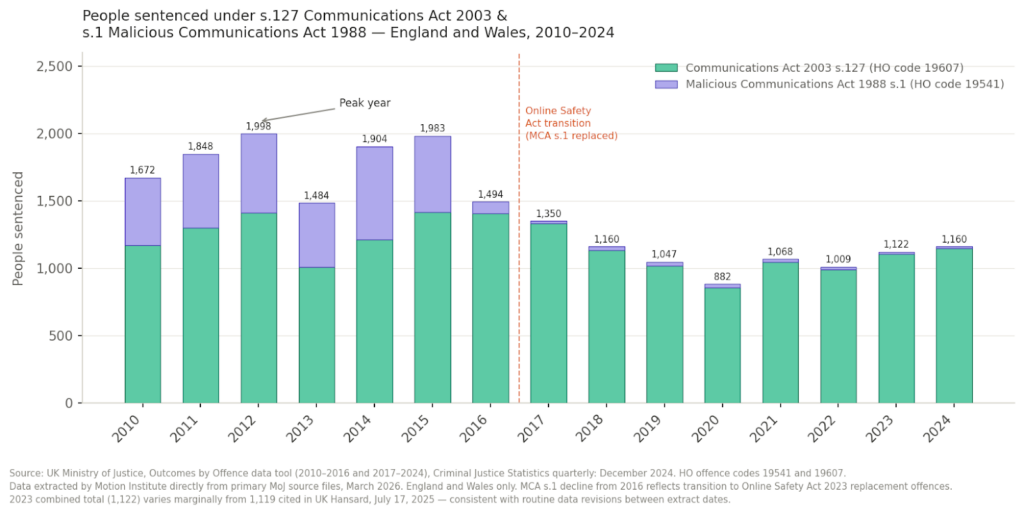
Figure 1: People sentenced under s.127 Communications Act 2003 & s.1 Malicious Communications Act 1988, England and Wales, 2010—2024. Source: UK Ministry of Justice, Outcomes by Offence data tool (2010—2016 and 2017—2024), Criminal Justice Statistics quarterly: December 2024. HO offence codes 19541 and 19607. Data extracted by Bearing Institute directly from primary MoJ source files, March 2026. Note: the combined peak year is 2012 (1,998 sentenced), not 2015 as previously reported — the 2015 figure of 1,995 cited elsewhere reflects CA s.127 convictions only. MCA s.1 decline from 2016 reflects transition to Online Safety Act 2023 replacement offences. 2023 combined total (1,122) varies marginally from 1,119 cited in UK Hansard, July 17, 2025 — consistent with routine data revisions between extract dates.
Convictions: What “Grossly Offensive” Has Meant in Practice
Matthew Woods — 12 weeks imprisonment, October 2012
Woods, then 19, posted dark jokes on his personal Facebook page about missing children April Jones and Madeleine McCann, adapted from material on the joke-sharing website Sickipedia. One post read: “Who in their right mind would abduct a ginger kid?” He was charged under Section 127 of the Communications Act 2003 for sending a grossly offensive message, pleaded guilty at Chorley Magistrates’ Court on October 8, 2012, and was sentenced to 12 weeks in a young offenders’ institute. Notably, comedian Frankie Boyle had posted a joke about Madeleine McCann to one million Twitter followers the same week; he was not charged. The bench chairman stated that “no right-thinking person in society should have” received the posts — a moral standard, not a legal one. The speech was offensive to some. It was not a threat. It was not incitement. It resulted in imprisonment.
David Perry — £700 fine plus £300 costs, December 2023
Perry pleaded guilty to sending a grossly offensive communication after emailing then-Deputy Labour leader Angela Rayner. The Crown Prosecution Service described the email as containing crude references to her appearance, calling her a “puppet of the industrial military complex,” and suggesting she “get off the news channels and go get a job in a fish factory.” Perry was fined £700 and ordered to pay £300 in costs. The email was insulting political speech directed at a public official. It contained no threat, no call to violence, and no incitement of any kind. It resulted in a criminal conviction.
James Watts — 20 weeks imprisonment, June 2022
Watts pleaded guilty to sending grossly offensive messages after sharing racist memes in a private WhatsApp group, including material mocking the death of George Floyd. West Mercia Police confirmed he was sentenced to 20 weeks in prison in June 2022. The content was genuinely offensive. It was shared in a private messaging group. It resulted in a custodial sentence under the same “grossly offensive” standard that Bill C-9 would import into Canadian law.
Who bears the burden: the age profile of speech offence sentencing
The individual cases above are not unrepresentative outliers. The aggregate picture — drawn from the same MoJ primary source data — reveals something that has never been publicly presented in this form. Over the fifteen years from 2010 to 2024, 771 children under the age of 18 were sentenced for speech offences under these provisions. Of those, 656 were aged 15 to 17, and 113 were aged 12 to 14. Two were aged 10 or 11 — the minimum age of criminal responsibility in England and Wales. Children aged 15 to 17 collectively received 102 months of custodial sentences. Some of those children went to prison for sending messages.
At the other end of the age spectrum, 91 people aged 70 or over were sentenced for speech offences over the same period — accumulating 61 months of combined custodial sentences. This is the demographic the Palestine Action arrests foreshadowed: almost half of the 522 people arrested in Parliament Square in August 2025 were over 60. The law does not draw the distinction between a 16-year-old posting offensive content online and a 74-year-old holding a placard. Parliament should consider whether Bill C-9 would draw that distinction in Canada — because the UK data suggests the enforcement machinery does not.
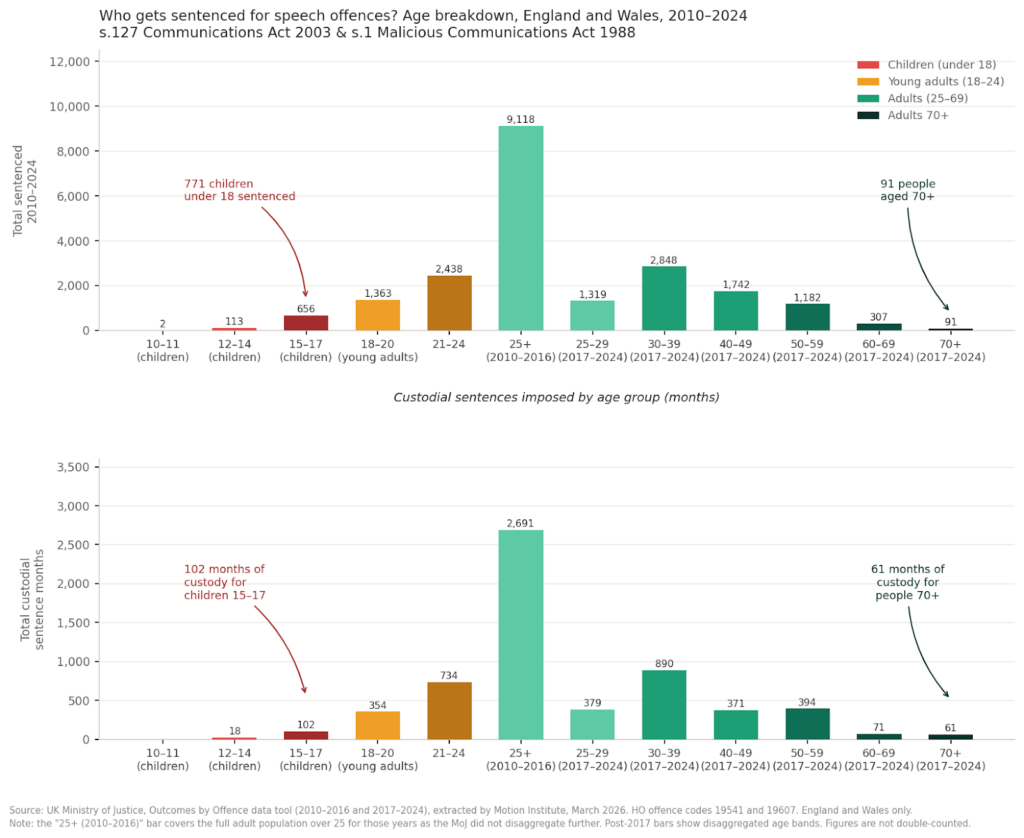
Figure 2: Age profile of people sentenced for speech offences under s.127 Communications Act 2003 & s.1 Malicious Communications Act 1988, England and Wales, 2010—2024. Top panel: total sentenced by age group. Bottom panel: total combined custodial sentence months by age group. Source: UK Ministry of Justice, Outcomes by Offence data tool (2010—2016 and 2017—2024), extracted by Bearing Institute directly from primary MoJ source files, March 2026. HO offence codes 19541 and 19607. Note: the MoJ did not disaggregate the 25+ adult population before 2017; the “25+ (2010—2016)” bar covers all adults over 25 for those years. Figures are not double-counted.
Arrests Without Conviction: The Chilling Effect in Action
The following cases did not result in conviction. They resulted in something arguably more consequential: the demonstrated willingness of state power to treat expression as a criminal matter, to arrest prominent citizens, and to impose the costs and trauma of the legal process on people who were ultimately found to have committed no crime. The financial cost of defending against even unsuccessful charges is rarely disclosed publicly — and that invisibility is itself part of the chilling effect. When citizens cannot know what it costs to be wrongfully arrested for speech, they are more likely to simply stop speaking.
Graham Linehan — arrested by five armed police at Heathrow Airport, September 1, 2025
Linehan, the Irish comedy writer who co-created Father Ted, The IT Crowd, and Black Books, stepped off an American Airlines flight from Arizona at Heathrow on September 1, 2025, and was met by five armed Metropolitan Police officers. He was arrested on suspicion of inciting violence over three posts he had written on X in April 2025 — four months earlier. One of the posts read: “If a trans-identified male is in a female-only space, he is committing a violent, abusive act. Make a scene, call the cops and if all else fails, punch him in the balls.”
Linehan was held in custody for 16 hours. His blood pressure spiked to dangerous levels and he was taken to hospital before being released on bail with conditions that he not post on X. He has since filed a lawsuit against the Metropolitan Police for wrongful arrest, false imprisonment, and breach of his free speech rights, represented by lawyers working with the Free Speech Union.
The arrest produced an extraordinary institutional response. Metropolitan Police Commissioner Sir Mark Rowley publicly stated that his officers were in an “impossible position” and called for the law to be “changed or clarified,” saying police should not be “policing toxic culture-wars debates.” UK Health Secretary Wes Streeting said ministers needed to “look at” online speech laws. Prime Minister Starmer said police must “focus on the most serious issues.” The arrest was raised before the United States House Judiciary Committee by Nigel Farage as evidence of the UK’s deteriorating speech freedoms.
The question for Canadian legislators is not whether one agrees with Linehan’s views on transgender issues. The question is whether five armed police officers should be dispatched to intercept a comedy writer at an airport over opinionated jokes expressed in tweets four months’ prior. The Metropolitan Police Commissioner himself said no.
Isabel Vaughan-Spruce — arrested twice for silent prayer; police apologised and paid £13,000, 2022—2024
Vaughan-Spruce is a Catholic charitable volunteer who had spent twenty years offering support to women outside a Birmingham abortion clinic. In November 2022, she was arrested by West Midlands Police inside a designated buffer zone — while standing in silence. When asked by an officer what she was doing, she replied that she “might be praying in her head.” She was arrested, searched, and charged. Birmingham Magistrates’ Court acquitted her of all charges in February 2023 after the prosecution was unable to offer supporting evidence.
Within weeks of her acquittal, she was arrested again in the same location for the same silent prayer. Six officers attended. One confirmed to her that “you’ve said you’re engaging in prayer, which is the offence.” That investigation was later dropped after she made legal representations. In August 2024, West Midlands Police formally conceded both wrongful arrests, false imprisonment, an intrusive search, and breaches of her human rights. They paid her £13,000 in settlement. The police explicitly apologised.
As of 2025, she is under a third investigation for the same silent prayers at the same location — prayers she has said weekly for two decades. The related case of Adam Smith-Connor, who was convicted in October 2024 and given a two-year conditional discharge for silently praying outside a Bournemouth clinic, resulted in an order to pay substantial prosecution costs.
Palestine Action protesters — 522 arrested for holding placards, August 9, 2025
After the UK Parliament proscribed Palestine Action as a terrorist organization in July 2025 — in a legislative package that bundled it with two neo-Nazi groups, requiring MPs to vote for all three or none — police moved to enforce the ban against public expression of support. On August 9, 2025, more than 500 people gathered in Parliament Square holding placards reading “I oppose genocide. I support Palestine Action.” The Metropolitan Police arrested 522 of them, the largest number of arrests made by the Met on a single day in the preceding ten years. Almost half of those arrested were over the age of 60. Among them was an 89-year-old retired psychotherapist.
Amnesty International described the arrests as “deeply concerning” and had previously criticized the law as “excessively broad and vaguely worded.” The United Nations’ human rights chief, Volker Turk, urged the UK government to lift the ban, calling the proscription a “disturbing” misuse of counter-terrorism legislation. By end of November 2025, British police had arrested at least 2,545 individuals for showing support for Palestine Action. On February 13, 2026, the High Court of Justice ruled that the proscription itself was unlawful.
Over 2,500 people were arrested for words on signs before a court determined that the underlying law was unlawful. The legal costs of those 2,545 individuals have not been publicly disclosed. That invisibility is precisely the point: broadly worded speech laws impose costs that are real, substantial, and effectively unquantifiable — which means no one is accountable for them.
The Hidden Cost: Police Hours Diverted from Violent Crime
The cases above document what broadly worded speech law does to citizens. There is a second consequence that has received almost no attention in Canadian parliamentary debate: what it does to police forces — and by extension to every other investigation those forces are no longer conducting.
666,000 hours — and 89% of violent crimes unsolved
The think tank Policy Exchange estimated in its November 2024 report that investigating non-crime hate incidents in the United Kingdom consumes approximately 60,000 hours of police time annually — based on roughly 13,000 incidents per year at up to five hours of investigation each. Cumulatively since 2014, that figure reaches 666,000 hours: the equivalent of employing more than 2,000 officers for a week.
The consequences of that diversion were placed directly into the parliamentary record on July 17, 2025, when Lord Lebedev — speaking in a House of Lords debate on online communication offence arrests, which he had secured — stated: “The think tank Policy Exchange has estimated that investigating these incidents has taken up to 666,000 hours of police time. Every hour devoted to policing speech is an hour not spent investigating phone theft, shoplifting, burglary or assault.” He continued: “When this is juxtaposed with 90% of all crime going unsolved in 2023 and 89% of violent or sexual offences going unsolved in 2024, it is hard to conceive of a worse waste of police time.”
That is not an advocate. That is a parliamentarian citing official crime statistics in the legislature of the country that has operated this regime longest. The five armed officers dispatched to Heathrow to meet Graham Linehan over four-month-old tweets were not available that day to investigate a burglary, an assault, or a sexual offence. The six officers who attended Isabel Vaughan-Spruce’s second silent prayer arrest — subsequently acknowledged by police as wrongful — were not available to investigate anything else. Each of the 12,183 arrests in 2023 and 9,700 arrests in 2024 consumed officer time. Nine out of ten violent or sexual offences in the United Kingdom went unsolved in 2024. These facts exist in the same country at the same time.
The incarceration cost: £18.74 million and counting
Beyond police hours, the UK’s speech law regime has imposed a direct and quantifiable cost on British taxpayers in prison expenditure alone. Bearing Institute extracted total custodial sentence months from the same MoJ source files used for Figure 1, and applied the MoJ’s own official cost figure of £51,108 per prisoner per year (£4,259 per month) from its published “Costs per place and costs per prisoner 2022—23” report. The result: between 2010 and 2024, custodial sentences for speech offences under s.127 Communications Act 2003 and s.1 Malicious Communications Act 1988 cost British taxpayers an estimated minimum of £18.74 million in prison costs alone.
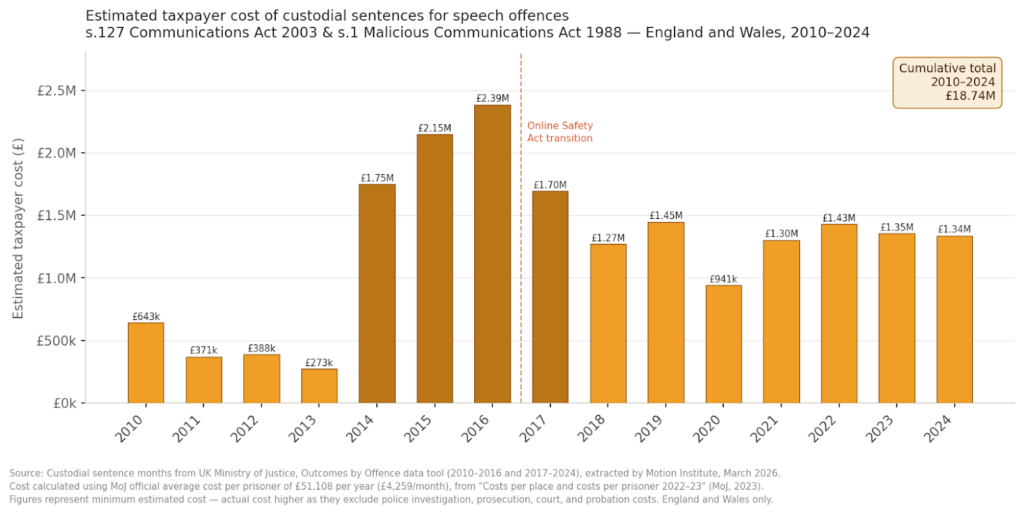
Figure 3: Estimated taxpayer cost of custodial sentences for s.127 Communications Act 2003 & s.1 Malicious Communications Act 1988, England and Wales, 2010—2024. Calculated by Bearing Institute using total custodial sentence months from MoJ Outcomes by Offence data tool (March 2026 extraction) and MoJ official cost of £51,108 per prisoner per year (£4,259/month), from “Costs per place and costs per prisoner 2022—23.” Figures represent minimum estimated cost — actual cost substantially higher as they exclude police investigation, prosecution, court, probation, and victim services costs. MoJ cost rate applied uniformly across all years; pre-2022 actual costs were lower, making earlier year figures slightly conservative.
This figure is a floor, not a ceiling. It captures only the cost of housing prisoners once sentenced. It excludes the police hours investigating each case, the Crown Prosecution Service costs of bringing charges, the court time consumed by each prosecution, and the probation and supervision costs following release. When those costs are included — as they must be for any honest accounting — the true taxpayer cost of the UK’s speech law regime over fifteen years runs to multiples of £18.74 million. Parliament has never been asked to weigh that cost against the harm the legislation was designed to prevent.
Canada’s prisons are already over capacity
The UK’s prison cost figures land in a Canadian context that makes them acutely relevant. Canada’s correctional system is not operating with spare capacity into which speech offence prisoners could be absorbed without consequence. It is operating in a documented crisis.
In the first six months of 2025, Ontario’s provincial jails averaged 10,800 prisoners against a maximum capacity of approximately 8,500 beds — 22 of 24 facilities were over capacity. The Vanier Centre for Women in Milton, Ontario’s only jail exclusively for women, recorded an occupancy rate of nearly 156%, housing 289 prisoners in a facility designed for 185. Chad Oldfield, Corrections Ministry Employee Relations Committee co-Chair representing the Ontario Public Service Employees Union, told CBC News on December 8, 2025: “The truth is that we don’t really have any space. We don’t have anywhere to put people. It really does highlight what we have been ringing the alarm bells on. It’s highlighting a system that’s at a breaking point, right? We’re in crisis.”
Ontario Ombudsman Paul Dubé, an independent officer of the Legislature, delivered an even more alarming assessment in his 2024—2025 Annual Report, released June 25, 2025. Dubé reported a 55% increase in complaints about correctional facilities in a single year — 6,870 cases, the highest in three decades — and described conditions his investigators observed firsthand during visits to twelve facilities across Ontario. “We’re finding people housed in broom closets and former pantries,” he told reporters at Queen’s Park. “The system has deteriorated and it’s in crisis.” In his written report, Dubé was unequivocal: “Ontario’s correctional system is in urgent need of meaningful, systemic reform. This is a matter of public safety, human rights, and basic decency. We cannot afford to ignore it any longer.”
The consequences of this overcrowding are already reverberating through the justice system in precisely the way Bill C-9’s proponents should consider. Dubé’s report documented that Ontario courts have been reducing sentences and granting early parole specifically because of unlawful treatment conditions in overcrowded facilities. Some accused persons have applied to have their charges — including murder charges — stayed on the basis of those conditions. The system is so overcrowded that it is not only failing to house the people sent to it — it is actively undermining prosecutions that the public depends on.
At the federal level, the incarcerated population increased by 7.8% in 2024—25 to 14,515, according to the Parole Board of Canada’s Performance Monitoring Report. The Correctional Service of Canada has acknowledged that double-bunking — housing two prisoners in a cell designed for one — has rebounded to pre-pandemic levels and will likely continue to increase. The CSC’s own departmental plan projects continued expenditure increases driven by population management pressures.
The cost of this crowding is not abstract. The average annual cost to incarcerate one person in a Canadian federal men’s prison is approximately $120,000, according to the Canadian Centre for Policy Alternatives citing federal data — with maximum security prisoners costing nearly $222,000 per year, as reported in a Correctional Service Canada submission to the Senate national finance committee in 2023. These are among the highest per-prisoner costs in the world.
Into this system — already over capacity, already double-bunking, already absorbing a 7.8% population increase in a single year — Bill C-9 would introduce a new category of offence that carries custodial sentences. The UK’s experience shows that speech offences, once criminalised, generate custodial sentences at scale. Between 2010 and 2024, UK courts imposed custodial sentences totalling thousands of months for speech offences alone. Canada’s federal prisons cost more than twice what UK prisons cost per prisoner. The fiscal arithmetic is straightforward — and Parliament has not done it.
The question is not only whether Canadians convicted of speech offences should go to prison. It is whether prison space that does not currently exist should be created for them — and if so, which violent offenders currently occupying that space will be displaced to make room.
The policing resource questions Bill C-9 has not answered
Canada is not starting from a position of surplus policing capacity. In British Columbia alone, police-reported hate crimes rose 23% between 2022 and 2023. In response, the provincial government invested $734,000 to expand its dedicated RCMP hate crimes unit from two officers to eight — adding five officers and one intelligence analyst specifically to manage the existing caseload. That investment was made to address the backlog before Bill C-9 adds a single new category of investigation.
Bill C-9 would materially expand the category of expression that police are required to investigate. It lowers the threshold for hatred, creates new symbol and obstruction offences, and removes the Attorney General’s gatekeeping function — meaning more complaints will flow to police, more investigations will be opened, and more officer hours will be consumed before a single case reaches a prosecutor.
Parliament has not publicly estimated the investigative burden Bill C-9 will impose. No regulatory impact assessment has been tabled quantifying how many additional investigations the expanded provisions are expected to generate annually, how many officer hours each investigation will require, or where those resources will come from. The federal government has already committed $20.2 million over six years to fund RCMP hate crime enforcement capacity — an acknowledgement embedded in the government’s own budget that existing resources are insufficient for the existing caseload. That commitment predates the expanded provisions in Bill C-9.
The United Kingdom enacted its communications offences legislation without answering those questions. The documented result is 666,000 hours of police time diverted from other investigations, and 89% of violent crimes going unsolved. Canada has the advantage of observing that outcome before legislating. Parliament should use it.
What the UK Experience Tells Canadian Legislators
The UK cases above are not outliers. They are the predictable output of a legal regime built on a vague emotional threshold, enforced without a meaningful gatekeeping mechanism, applied to an ever-expanding category of expression. Twelve weeks in prison for Facebook jokes. A criminal conviction for a rude political email. Five armed police meeting a comedy writer at an airport over tweets about transgender issues. An 89-year-old arrested in Parliament Square for words on a sign. A woman arrested three times for silent prayer. Over 2,500 people arrested under a law that a court later ruled unlawful.
None of these outcomes required bad intentions on the part of legislators. They required only what Bill C-9 also contains: a vague standard, removed accountability, and the ordinary operation of state power. The Metropolitan Police Commissioner — the head of the force that arrested Graham Linehan with five armed officers — said publicly that the law needed to change and that police should not be policing culture-war debates. That is not a radical civil liberties position. That is the senior law enforcement official of the United Kingdom acknowledging that the system had produced results inconsistent with a free society.
Canada has an opportunity the UK did not have: to observe two decades of consequences before legislating. The recommendations that follow are designed to preserve the genuine goals of Bill C-9 — protecting communities from hatred in its most serious manifestations — while avoiding the structural features that have made the UK experience a warning rather than a model.
Recommendations for Legislative Consideration
Bill C-9 is expected to proceed to third reading in the House the week of March 23, 2026, before proceeding to the Senate. Bearing Institute notes two significant committee wins, identifies three outstanding concerns requiring Senate attention, and adds two structural recommendations that apply regardless of the bill’s current form.
Committee amendments Bearing Institute supported—and outstanding concerns
- The Supreme Court threshold for hatred — partially addressed. The committee restored the language from R. v. Keegstra and Whatcott, requiring extreme manifestations of detestation and vilification to establish hatred. Bearing Institute commends this amendment. However, the Senate should scrutinize whether the full statutory definition as enacted is precisely consistent with the Supreme Court’s formulation in both Keegstra and Whatcott, and should not pass the bill if any ambiguity remains that could allow prosecutions below that constitutionally mandated threshold.
- The Attorney General’s consent requirement — retained by committee. The committee chose not to remove the requirement for the Attorney General’s personal consent to hate propaganda prosecutions. Bearing Institute commends this decision. The Senate should ensure this retention is unambiguous in the final text and should support the position of ALCCA that enhanced transparency around consent decisions and policy guidelines for consistent and timely decision-making would further strengthen this safeguard.
Outstanding concerns requiring Senate action
- Restore the religious expression exemption — the committee’s most damaging amendment. The committee voted to repeal section 319(3)(b) of the Criminal Code — the good faith religious expression defence — at the urging of the Bloc Québécois, backed by Liberal committee members. This defence has never successfully shielded genuine hate speech from prosecution. Its only practical function has been to protect religious communities’ ability to read, discuss, and express the content of their own scriptures. Its removal is opposed by the Canadian Conference of Catholic Bishops, the Evangelical Fellowship of Canada, Independent Jewish Voices, the Canadian Muslim Public Affairs Council, the Canadian Civil Liberties Association, and dozens of other organizations representing millions of Canadians. The Senate should restore this defence. A provision that has produced no demonstrated harm in decades of operation has been removed in response to ideological pressure rather than documented legal failure.
- Clarify the scope of the obstruction offence. The obstruction provision should include explicit safe harbour language for peaceful assembly, picketing, and protest — including at multi-use facilities that include religious or cultural spaces. The current communicative-expression exception is insufficient to prevent the chilling of lawful protest. This concern was not resolved by committee.
- Remove the symbols offence entirely — or, failing that, apply the full suite of safeguards. Bearing Institute’s primary position is that the symbols offence should be struck from Bill C-9. Displaying a genuine hate or terrorist symbol with intent to promote hatred is already captured by sections 318 and 319 of the Criminal Code, which carry the AG consent requirement and the Supreme Court threshold. The symbols offence adds no prosecutorial reach against genuine hate while creating conditions — vague field-level standards, no AG consent requirement for arrests, cabinet-defined criminal lists — that are structurally identical to the UK enforcement regime that produced 522 arrests in a single day for words on signs. If Parliament proceeds with the offence despite this analysis, it must at minimum: define the full list of prohibited symbols by statute rather than regulation; extend the AG consent requirement to arrests under this provision; and include an explicit good faith and contextual use defence.
Structural recommendations applicable at all stages
- Ensure full Senate study. The government invoked closure in the House on March 9, 2026, directing the Justice Committee to conclude clause-by-clause review without further debate and to report within two sitting days. The result was a bill reported back to the House on March 13 — four days after debate was shut down — with amendments that dozens of civil society organizations had not had adequate opportunity to address. The Senate should conduct the thorough study the House was prevented from completing, including testimony from the Canadian Conference of Catholic Bishops, the Canadian Muslim Public Affairs Council, Independent Jewish Voices, the Canadian Civil Liberties Association, the Canadian Bar Association, and other organizations that raised unresolved concerns.
- Require a resource impact assessment. The government has not tabled a regulatory impact assessment estimating the annual volume of new investigations the expanded provisions are expected to generate, the officer hours each category of investigation will require, or the source of additional enforcement capacity. The federal government has already committed $20.2 million over six years to RCMP hate crime enforcement — an acknowledgement that existing resources are insufficient for the existing caseload. The Senate should require this assessment before passing the bill. The United Kingdom enacted comparable legislation without asking these questions; the documented result is 666,000 hours of police time diverted from other investigations and 89% of violent crimes going unsolved.
Bearing Institute is a Canadian public-policy institute focused on legislative research and ready-to-table amendments. Should these observations be useful during third reading debate or Senate consideration of Bill C-9, we would be pleased to provide further analysis.
Alexis Roumanis
Matthew Trenholm
Alexis Roumanis, M.Pub., is a co-founder of the Bearing Institute, a children’s book author with more than 100 published titles, and a published researcher at the Canadian Centre for Studies in Publishing. He recently submitted a policy brief on Bill C-223 to the Standing Committee on Justice and Human Rights.
Matthew Trenholm, MSc, is a co-founder of the Bearing Institute and a published researcher in the Journal of International Health Sciences and Management.
This submission was co-authored by Alexis Roumanis and Matthew Trenholm.
PDF (secondary)
If you prefer, you can also view the original PDF below.
Need a legislative-ready submission?
We produce rigorously cited research and tabling-ready recommendations designed for the legislative process.